
Relapsed and refractory high-risk neuroblastoma in the bone or bone marrow sits in the hardest corner of pediatric oncology. Chemoresistant cells in these compartments seed the relapses that drive mortality. Therapeutic options to clear them have been limited. The FDA's accelerated approval for DANYELZA marked the first humanized anti-GD2 monoclonal antibody approved for this disease state.
The evidence rests on two open-label, single-arm studies. Study 201 was the multicenter pivotal trial, and Study 12-230 was the single-center companion. Accelerated approval rests on overall response rate and duration of response, with continued approval potentially contingent on confirmatory trials.
Trial Design and Population for the Danyelza Pivotal Study
Trial 201 was a global, single-arm, open-label Phase 2 trial. Sites spanned the United States, Canada, Denmark, Germany, Italy, Spain, and Hong Kong. Eligibility required high-risk neuroblastoma patients aged at least 12 months with bone or bone marrow involvement and an incomplete response to induction or relapse therapy.
Patients with actively progressing disease or evaluable neuroblastoma outside the bone or bone marrow were excluded. Prior anti-GD2 therapy was permitted. At least one prior systemic therapy directed at disease outside the bone or bone marrow was required.
The treatment schedule was 3 mg/kg per infusion, up to 150 mg per day, on Days 1, 3, and 5 of each 28-day cycle. The total dose was 9 mg/kg per cycle, administered with subcutaneous GM-CSF. The first infusion of Cycle 1 ran 60 minutes. Subsequent infusions ran 30 to 60 minutes as tolerated. Independent pathology and imaging review evaluated effectiveness using the revised International Neuroblastoma Response Criteria.
Study 12-230, the companion single-center Phase 1/2 trial, enrolled 72 patients under overlapping criteria. The two-trial dataset gave the FDA both multicenter and single-center views of activity in the same indicated population.
Baseline characteristics reflected heavy pretreatment. Median age was 5 to 6 years. MYCN amplification was present in 14 to 16 percent of patients. INSS Stage 4 disease was present in 86 to 95 percent. Prior chemotherapy was nearly universal. Prior anti-GD2 antibody treatment ranged from 18 to 58 percent across the studies.
Efficacy Data from the Danyelza Trial 201 Prespecified Interim Analysis
The Trial 201 for Danyelza’s efficacy included 22 efficacy-evaluable patients. The overall response rate was 45 percent, with a 95 percent confidence interval of 24 to 68. Complete responses occurred in 36 percent and partial responses in 9 percent. Median duration of response was 6.2 months. Thirty percent of patients had a duration of response of at least six months.
The Study 201 pre-specified interim analysis expanded the efficacy population to 52 patients. The overall response rate was 40 percent, with a 95 percent confidence interval of 27 to 55. Complete responses occurred in 29 percent and partial responses in 11 percent. Median duration of response was not estimable. Nineteen percent of patients had a duration of response of at least six months at a median follow-up of 5.9 months.
Study 12-230 included 38 efficacy-evaluable patients. The overall response rate was 34 percent, with a 95 percent confidence interval of 20 to 51. Complete responses occurred in 26 percent and partial responses in 8 percent. Twenty-three percent of patients had a duration of response of at least six months.
Responses were observed in the bone, bone marrow, or both across all three analyses. Independent pathology and imaging review adjudicated every response. The convergence across two studies supports the consistency of the activity signal in the indicated population.
What the Subgroup Data Show in the Pre-specified Interim Analysis
The Study 201 pre-specified interim analysis included pre-specified subgroup analyses of the primary endpoint. Among 26 patients with incomplete response to induction therapy, the overall response rate was 46 percent. Complete responses occurred in 31 percent and partial responses in 15 percent.
Among 26 patients with incomplete response to relapse therapy, the overall response rate was 35 percent. Complete responses occurred in 27 percent and partial responses in 8 percent. The split across induction-incomplete and relapse-incomplete subgroups shows activity in both settings.
Prior anti-GD2 exposure produced a notable signal. Among 13 patients with prior anti-GD2 therapy, the overall response rate was 31 percent. Among 39 patients without prior anti-GD2 therapy, it was 44 percent. Prior exposure is not an automatic contraindication to subsequent DANYELZA use within the indicated population.
Among 18 patients who developed anti-drug antibodies during treatment, the overall response rate was 22 percent. Subgroup figures carry standard caveats. Small sample sizes could represent chance findings, and the analyses were not adjusted for multiplicity. The data points inform rather than dictate patient selection.
Safety Profile from the Danyelza Trial 201: Safety Population
Infusion-related reactions of any grade occurred in 100 percent of Study 201 patients and 94 percent of Study 12-230 patients. Grade 3 or 4 infusion reactions occurred in 68 percent and 32 percent, respectively. Serious infusion-related reactions occurred in 4 percent and 18 percent.
Hypotension of any grade occurred in 100 percent of Study 201 patients and 89 percent of Study 12-230 patients. Pain of any grade occurred in 100 percent and 94 percent. Grade 3 pain occurred in 72 percent of Study 201 patients. Anaphylaxis occurred in 12 percent of Study 201 patients, with two patients (8 percent) permanently discontinuing. One Study 12-230 patient experienced Grade 4 cardiac arrest 1.5 hours after a DANYELZA infusion.
The Study 201 pre-specified interim analysis characterized the resolution profile. Among patients with Grade 3 pain, 90 percent resolved within five hours, and the majority resolved within one hour. Among patients with Grade 3 or 4 hypotension, 89 percent resolved within five hours, and the majority within one hour. The events are common, but they resolve quickly under structured management.
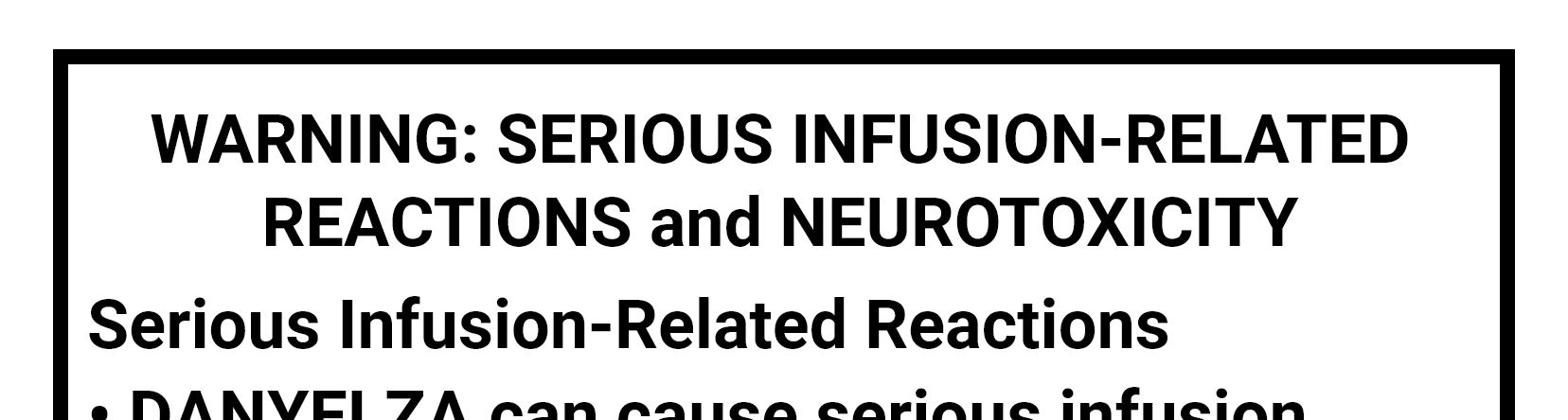
DANYELZA carries a boxed warning for serious infusion-related reactions and neurotoxicity. Permanent discontinuation applies for Grade 4 or unresponsive Grade 3 infusion reactions, Grade 3-4 anaphylaxis, transverse myelitis at any grade, and reversible posterior leukoencephalopathy syndrome at any grade. Serious adverse reactions led to permanent discontinuation in 8 to 12 percent of patients across the studies.
How to Apply the Trial Data Through Population Matching
The narrow eligibility criteria are the data's greatest interpretive strength. The findings apply to patients matching the trial population. That means pediatric patients one year of age and older and adult patients with relapsed or refractory high-risk neuroblastoma in the bone or bone marrow who demonstrated a partial response, minor response, or stable disease to prior therapy.
Patients outside these parameters fall outside both the indication and the data. Patients with evaluable neuroblastoma outside the bone or bone marrow and patients with active disease progression were excluded from the trial dataset. Stretching the results to these populations overreaches what the studies demonstrated.
The pre-specified subgroup data within the eligible population are useful for nuanced patient selection. Patients with incomplete response to either induction or relapse therapy showed activity. Patients with or without prior anti-GD2 exposure showed activity, with higher response rates in those without prior exposure.
Imaging that documents bone or bone marrow involvement and response assessment to the most recent line of therapy together confirm naxitamab eligibility. Assessment of bone and bone marrow disease requires both MIBG imaging and biopsy. Programs that build this into routine relapse workup capture eligible patients earlier in the disease course.
Apply the Danyelza Evidence to Your Patient Population
The registrational dataset across Study 201 and Study 12-230 demonstrates activity in a defined population. Independently reviewed response rates, the characterized safety profile, and severe-event resolution patterns support outpatient delivery in programs with the appropriate monitoring infrastructure. DANYELZA is currently administered at more than 60 US healthcare institutions and growing. Median cycles completed in the Study 201 pre-specified interim analysis was seven.
Full prescribing information, clinical data summaries, and HCP support tools for Danyelza are available at DanyelzaHCP.com.
Sources
- DANYELZA (naxitamab-gqgk) [package insert]. New York, NY: Y-mAbs Therapeutics, Inc.; 2024. https://labeling.ymabs.com/danyelza
- Park JR, Bagatell R, Cohn SL, et al. Revisions to the International Neuroblastoma Response Criteria: A Consensus Statement From the National Cancer Institute Clinical Trials Planning Meeting. J Clin Oncol. 2017;35(22):2580-2587. https://pubmed.ncbi.nlm.nih.gov/28471719/